


The €40,000 per MW per Year Gap: What Drives Financial Performance in Industrial Battery Systems?
Same battery.
Same capacity.
Up to €40,000 per MW per year difference.
This gap is entirely driven by how the battery is operated.
What Determines Battery Performance
1. Multi-market access: Smartly combining imbalance, reserve markets FCR and aFRR, and the intraday market through dynamic optimisation instead of single-market focus.
2. Peak shaving 2.0: Actively monitoring and reducing 15-minute peaks to structurally lower grid fees, while trading in parallel.
3. Local optimisation: Maximising the use of your own renewable energy at the right moments.
4. Your energy contract: If the contract is not adapted to flexibility, optimisation efforts lose impact.
5. VPP advantage: The strategic power of a large-scale Virtual Power Plant.
Close Your €40,000 per MW per Year Gap
Whether you already operate a battery or are considering one, clarity starts with insight.

Option 1: Independent Battery Revenue scan (30 min)
Providing you with:
– Your highest-value market opportunities
– The interaction between trading and grid costs
– The impact of your energy contract
– The advantage of joining a 30 MW pool (with >140 MW in the pipeline)
Battery Revenue Scan
Schedule your independent ROI assessment here
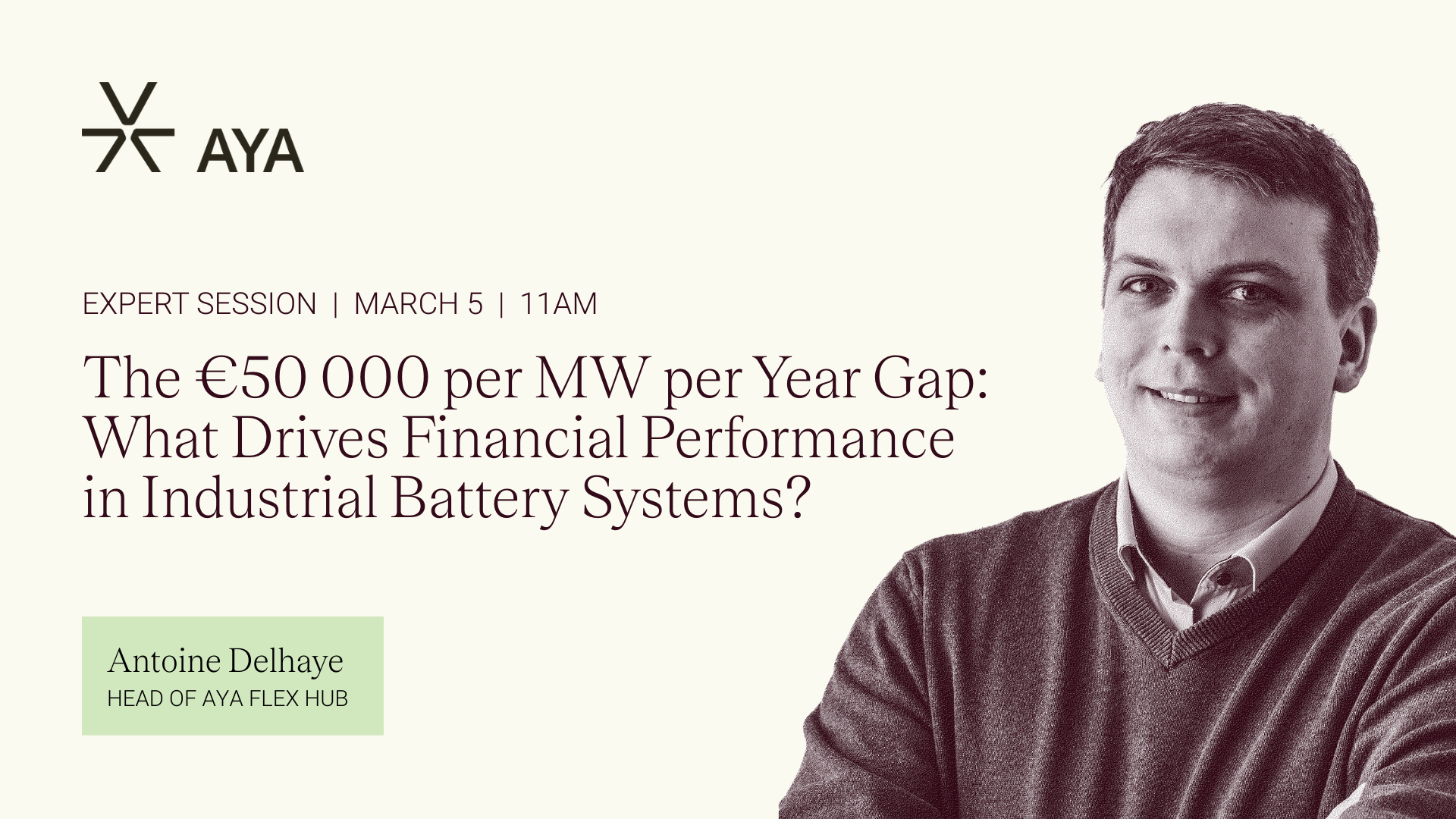
Option 2: Join the Webinar
Whether you already operate a battery, are currently evaluating an investment, or are exploring how to reduce your energy costs, this expert session provides the insights needed to move from a standard setup to a high-performer.
During this webinar, we cover:
– Multi-Market Access
– Energy Contract Alignment
– Peak Shaving 2.0
– The Virtual Power Plant Advantage
– Profitability and ROI
Practical Information
– Thursday, March 5, 2026
– 11:00 AM
– Host: Antoine Delhaye, Head of AYA Flex Hub
The Impact of Optimised Operation
When all performance drivers are aligned:
– Higher net energy market revenues
– Controlled grid cost exposure
– Stable integration with your energy contract
– Reduced volatility impact
– Improved ROI certainty
Read more

Demand Flexibility Service saves over 3.3GWh of electric
The UK's National Grid ESO Demand Flexibility Service (DFS) has saved over 3.3GWh of electricity during peak times over the winter of 2022/23. The scheme, which had 22 service events and was open from 1 November 2022 to 31 March 2023, saw 1.6 million households and...

We reduce the impact of your energy consumption on your bottom line and the planet
At AYA, we provide a unique, coherent approach for energy-intensive industries in Europe. 'Those who do not embrace the green and sustainable energy transition will quite literally face the financial consequences. During the energy crisis, the energy market has...
